News
Skip forward to 17:50 in the broadcast to hear Matt Well's piece with Jim and Maryann
A Web-based Penn State Extension course designed to help beginning and experienced beekeepers gain the knowledge they need to be successful has been recognized for online excellence.
Since formation of the Colony Collapse Disorder (CCD) Steering Committee early in 2007, the U.S. Department of Agriculture (USDA), U.S. Environmental Protection Agency (EPA) and public and private partners have invested considerable resources to better address pollinator declines and major factors adversely affecting bee health. Several individuals from the Committee, along with Pennsylvania State University, organized and convened a conference on in October 2012 that brought together stakeholders with expertise in honey bee health. This new report is the product of unprecedented collaboration and shows that there is much work yet to do. The key findings are summarized below.
The danger that the decline of bees and other pollinators represents to the world’s food supply was highlighted this week when the European Commission decided to ban a class of pesticides suspected of playing a role in so-called “colony collapse disorder.”
With populations of wild and domesticated pollinators, such as honeybees, in decline, some of the world's foremost scientists in the field will converge on Penn State this summer to discuss the latest research aimed at understanding and overcoming challenges to pollinator health.
Honeybees have probably the largest and most loyal following of any insects in the animal kingdom. Honey is considered the most natural and purest sweetener, beeswax the only proper substance for candles in churches, and the bees’ work as pollinators is lauded as so essential, we’d all starve without their services.
We have an outstanding group of internationally renowned speakers, with sessions including behavioral ecology, physiology and development, host-parasite interactions, ecology and conservation, ecosystems services, and policy. A theme of the conference will be examining and mitigating the effects of environmental contaminants on pollinators.
The Penn State Department of Entomology is seeking undergraduate student applicants for the Dutch Gold Honey Scholarship for honey bee research.
UNIVERSITY PARK, Pa. – The Center for Pollinator Research at Penn State will be hosting the second International Conference on Pollinator Biology, Health and Policy from August 14-17, 2013. The conference will be held at Penn State’s campus in University Park, PA.
Shelby Fleischer and David Biddinger are members of a US-wide consortium of researchers and Extension specialists who received funding from the USDA to study pollination of multiple specialty crops in different regions throughout the country.
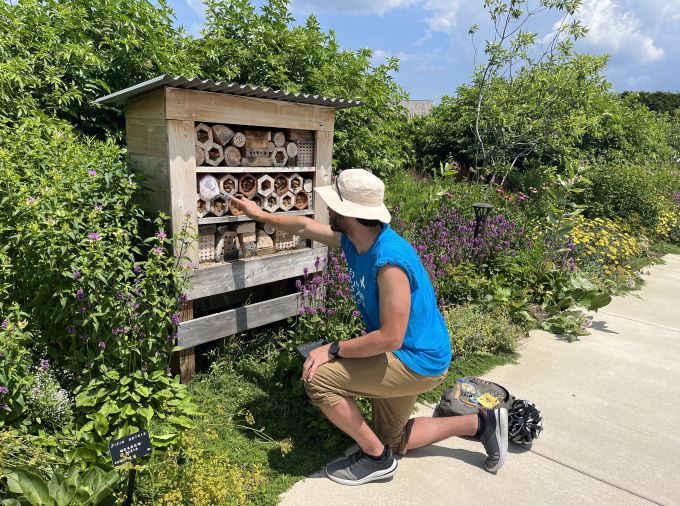
Several public pollinator gardens have been developed in recent years throughout Centre County. These gardens not only display the breathtaking diversity of pollinators and pollinator-friendly plants, but can also serve as examples for homeowners, commercial businesses, and growers interested in developing pollinator-friendly gardens and habitat on their properties.
Megan Snyder, a sophomore studying Immunology and Infectious Disease with a minor in Entomology and Christina Folmar, a junior studying Agroecology at the University Park campus are the recipients of the 2012 Dutch Gold Honey Undergraduate Research Award.
WPSU recently aired a story about the Penn State Queen Rearing Workshop, the PA Queen Breeding Program, and the associated Penn State research on queen rearing and honey bee stock improvement. The story can be streamed online here:
UNIVERSITY PARK, Pa. -- Beginner and experienced beekeepers and those thinking about taking up backyard beekeeping can get the information they need to be successful from Beekeeping 101, a new online beekeeping course offered by Penn State Extension.
Michael Freiberg recently graduated with a BSc and MSc from the Department of Entomology. He visited the University of São Paulo, Ribeirão Preto, São Paulo, Brazil, in May and June of 2011, with support from the College of Agricultural Sciences International Office.
Lecture by Christina Grozinger in the 2012 Penn State Frontiers in Science lecture series, is now available online
The Penn State Department of Entomology is seeking undergraduate student applicants for the Dutch Gold Honey Scholarship for honey bee research.
We will be hosting our second annual Queen Rearing Workshop at Penn State from June 2-3, 2012.
The symposium will be held on May 21, 2012, and will feature presentations from Center members and regional collaborators from the NE IPM Center Pollinator Working Group. Topics will include basic and applied research, extension and outreach related to pollinators.
In 2010, honey distributor Dutch Gold Honey and William and Kitty Gamber, of Lancaster, Pa., each contributed $50,000 to endow a fund to support undergraduate research in the College of Agricultural Sciences.